
Teen Patti vs Baccarat: How the Rules and Betting Differ
What Is Baccarat?
Baccarat is a card game with two named positions: the Player hand and the Banker hand. You predict which will finish with the higher score, or whether they will tie. These labels identify positions, not roles you must personally occupy.
This guide covers standard Punto Banco, the common casino format. Cards are dealt and drawn according to fixed rules, making participation straightforward once you understand scoring. Other Baccarat variants can involve different decisions. MGM’s Baccarat guide.
How to Play Baccarat
A typical round follows these steps:
Read the table rules. Check the minimum stake, commission and payout schedule.
Choose your wager. The main options are Player, Banker and Tie.
Place your chips before betting closes. Confirm the amount before the deal begins.
Watch the opening deal. Both hands receive two cards.
Calculate the scores. Add the card values and keep only the last digit.
Follow the drawing rules. A third card is dealt when required, as explained below.
Check settlement. The higher final total wins; equal totals produce a tie.
You do not choose whether either position takes another card. PokerStars’ rules guide.
For Android, you need a compatible device and either a supported browser or the operator’s verified application. Check its stated software requirements and your connection. Exact compatibility depends on the service; an app download is not universally required.
Teen Patti vs Baccarat: Rules to Know
How the Games Compare
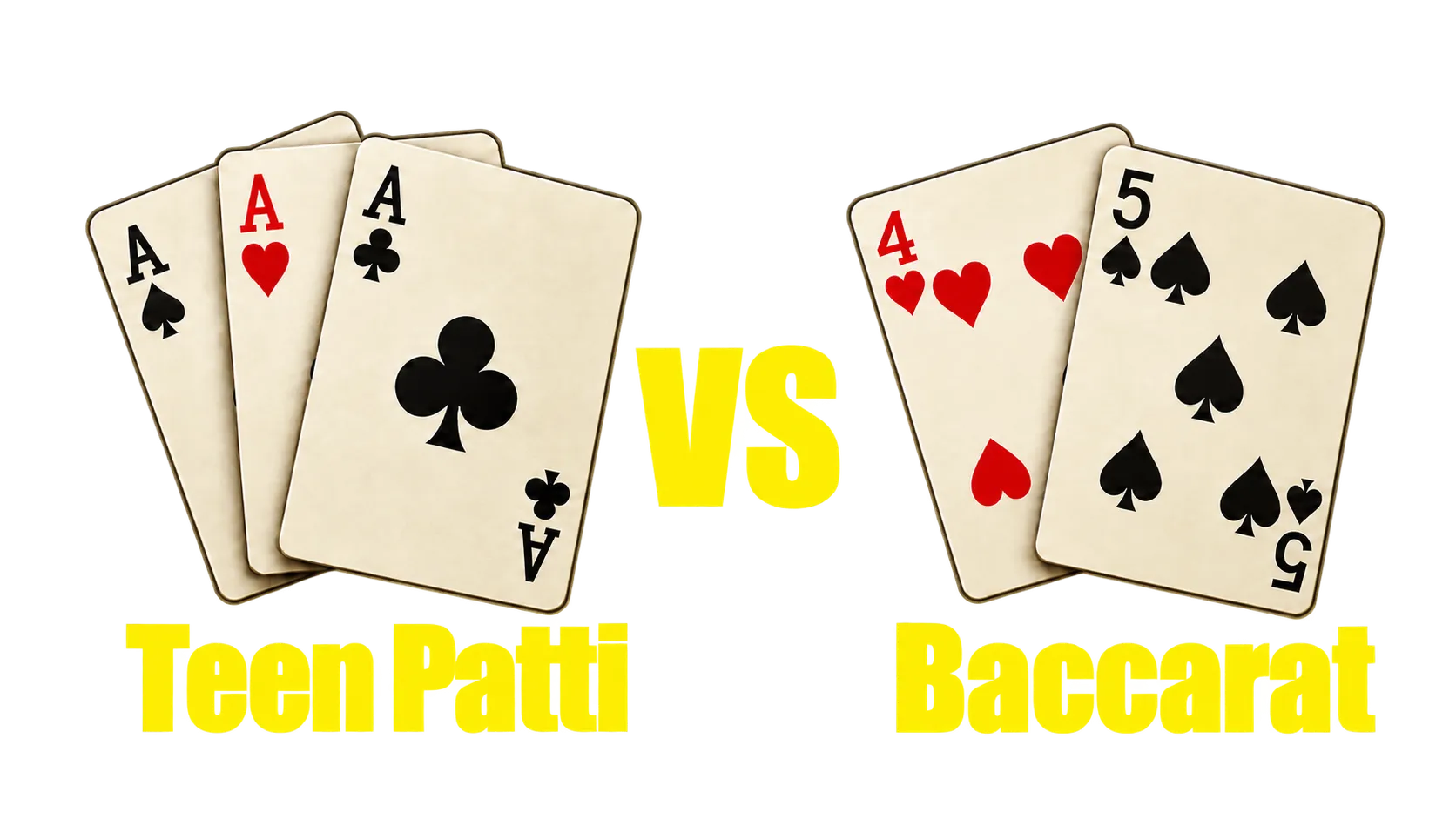
Classic Teen Patti uses three-card combinations and a shared pot. Participants can play blind or seen, continue betting, or fold. A weaker combination can win when everyone else withdraws. Traditional Teen Patti rules.
Baccarat has no equivalent bluffing contest. Your choice of wager does not persuade either position to fold or change how cards are drawn.
| Feature | Classic Teen Patti | Standard Baccarat |
|---|---|---|
| Winning basis | Ranked card combinations | Higher final point total |
| Cards per hand | Three | Two or three |
| Main decisions | Blind/seen play, betting, folding | Select a wager before dealing |
| Opponents | Other participants | Predict two designated hands |
| Main return | Shared pot | Posted payout schedule |
| Bluffing | Can influence opponents | No role in drawing or settlement |
Casino games labelled Teen Patti may replace traditional pot betting with fixed wagers. Compare the actual rules rather than relying on the title alone.
Card Values and Hand Totals
Baccarat card values are simple:
Ace: one point.
Two through nine: face value.
Ten and face cards: zero points.
Suits do not affect the main result. A pair or matching suits does not make a stronger main hand, although separate bonus wagers may recognise such features.
Add the values, then retain only the last digit. For example, 7 + 8 = 15 becomes 5; King + 9 becomes 9. There is no “bust” when the sum exceeds nine. Card-value explanation.
Once all required cards have been dealt, the greater total wins. A final 6 beats 5: neither hand needs eight or nine to win. Equal scores produce a tie, regardless of the individual card ranks.
Naturals and the Player’s Third Card
An initial two-card total of 8 or 9 is a natural. If either position has a natural, neither receives another card. A natural eight still loses to a natural nine; “natural” does not mean an automatic winning bet.
If neither position has a natural:
The player’s hand draws on 0–5.
The player’s hand stands on 6–7.
If Player stands, Banker draws on 0–5 and stands on 6–7.
These are compulsory actions, not recommendations. Regulator-published Baccarat drawing rules.
When the Banker Draws
If Player receives a third card, the banker’s action depends on its existing total and the value of Player’s additional card, not Player’s final total.
| Banker’s two-card total | Draws when Player’s third-card value is |
|---|---|
| 0, 1 or 2 | Any value |
| 3 | Any value except 8 |
| 4 | 2-7 |
| 5 | 4-7 |
| 6 | 6 or 7 |
| 7 | Never; stands |
For example, Banker on three stands when Player receives an eight. Banker on five draws when Player receives a six. In all cases, check for naturals before applying the chart. Official table of play.
Payouts, Commission and Betting Limits
A common commission table pays a winning Player bet at 1:1. Winning Banker bets pay 1:1 less 5% commission on winnings, equivalent to 0.95:1 net profit. A Tie bet commonly pays 8:1; on a tie, main Player and Banker stakes are returned. Hard Rock’s published payouts.
For an illustrative 100-unit winning Banker wager, the profit is 95 units and the original stake is returned. This example describes settlement, not a recommended bet amount.
“No commission” does not necessarily mean better returns. Some versions pay only 1:2 when Banker wins with six; other variants use different exceptions. Read the specific schedule. Commission-free rule example.
Under common eight-deck commission rules, approximate house edges are 1.06% on Banker, 1.24% on Player and 14.36% on an 8:1 Tie wager. These figures describe long-run mathematical disadvantage, not a prediction for your session. Published return figures.
Set money and time limits before starting. Increasing stakes after losses does not remove that disadvantage. A results board records earlier outcomes; a visible streak alone is not a reliable forecast.
Car Roulette
“Car Roulette” is not a standard Baccarat term. If it means roulette, bets cover a number or group of numbered pockets; the wheel also contains green zero pockets, depending on the variant.
Andar Bahar
Andar Bahar uses a standard deck and a main reference card, often called the joker. The goal is to predict which side first receives a card matching that reference rank.
Dragon Tiger
Dragon Tiger compares a card in each named box. The higher-ranked card determines the winning side, subject to its rules. Unlike Baccarat, the main feature is rank comparison rather than added totals. Related-game descriptions.
Frequently Asked Questions
What Is Baccarat?
Baccarat is a card game where you predict whether Player or Banker will finish closer to nine, or whether they will tie. Standard Punto Banco uses compulsory drawing rules. It differs from classic Teen Patti, where participants compare three-card combinations and make betting decisions against each other.
What Works When Learning Baccarat?
Practise counting totals, understand the drawing chart and check the payout schedule before placing a wager. Set a fixed spending and time limit. These habits help control mistakes and expenditure; they do not predict cards or guarantee profit.
What Should I Watch Before Playing?
Check whether the table charges Banker commission or uses an alternative settlement rule. Read Tie and side-bet payouts, stake limits and withdrawal conditions. A familiar interface or a long results history does not establish fair operation or favourable odds.
What Are the Three Main Bets in Baccarat?
Player predicts a higher final Player total; Banker predicts a higher final Banker total; Tie predicts equal totals. Common commission rules pay Player at 1:1, Banker at 1:1 less 5% commission, and Tie at 8:1. Check the table because variants change payouts.
Is Baccarat a Game of Skill or Luck?
In standard Punto Banco, the deal determines the result and drawing decisions are automatic. Choosing wagers affects expected cost, but bluffing cannot influence either hand. Classic Teen Patti allows decisions against opponents, although chance still determines the cards received.
Is Baccarat Fair?
Fairness must be assessed for the specific operator and game, not assumed from the name. Look for verifiable licensing, applicable testing information, clear rules and a dispute process. A correctly operated game can still favour the casino mathematically and produce losing sessions.
Did the Baccarat App Install Successfully?
That cannot be established from a guide or a welcome message. Check your device’s app list and confirm the application opens and identifies the expected publisher. If you use a supported browser version, installation may not be necessary.
The practical choice in teen patti vs baccarat is between a game involving opponent decisions and one governed by fixed scoring and drawing rules. Choose based on the experience you understand, confirm the exact version and payout schedule, and practise without money before considering real stakes. Neither format offers guaranteed income, and simpler decisions do not make gambling risk-free.